For more than 30,000 years human beings have adopted creative and artistic mediums with a goal to convey an experience or emotion, with the aim to evoke the feeling of empathy with a situation or location.
From the early paintings depicting scenes of hunting in places like the caves of Chauvet, France and the bone carvings of our earliest ancestors in Africa, its evident that humans with a creative notion have devoted much time and effort to creating art and telling visual stories that move others. This trait has never waned, in fact the opposite; as more methods for conveying stories have materialised and become accessible to many rather than a few, the number of storytellers and artistic expressionists are now pretty much all of us. Nowadays most of us have the tools in our pocket to capture word, record video and audio, and to share our own stories in real time across social platforms.

The tools have changed
The core notion of documenting and conveying something to our fellow man is the same, what has changed (or at least developed) are the tools we can use and the accessibility of the stories to many rather than a few.
From cave paintings and renaissance painters to the Lumière brothers’ first silent movies (that had viewers running in fear from the screen), to the the first audio recordings, 3D movies and triple A computer games, to now the new revolution in creative mediums of AR, VR and MR; the breadth of means of expression has grown exponentially. But in keeping with this exponential growth in choice of medium has always been the ability and appetite for humans to adopt them.
It took many thousands of years for the art of expression through cave painting to spread beyond its early practitioners, and it didn’t spread everywhere. It took well over 3 decades for the TV to become commonplace in people’s homes after its invention - whereas “smart” phones have pretty much become ubiquitous in the last 5 years. We are now more than ever ready to adopt a new paradigm in communication as a super quick rate.
Virtual Reality (VR), Augmented Reality (AR) and soon Mixed Reality (MR) are about to revolutionise how we as humans communicate, learn, work, create and enjoy art, however it won’t be a slow adoption. I’ve been fortunate enough to have given people their first VR experience during the past couple of years and have seen first hand how skepticism quickly falls away when I firmly plant a VR headset onto a user. The skepticism is quickly followed by joy, then the desire to own or consume more VR.
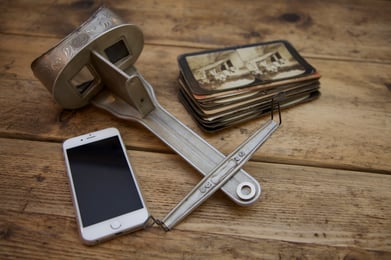
The new revolution will be more than just TV
Talking about a revolution may seem premature as the general public are still pretty unaware as to VR. Probably the most well known of the imminent set of headsets on their way to market is the Oculus Rift (due to its $2 billion acquisition by Facebook and its founder, Palmer Luckey’s recent Time Magazine front cover), which is due for Consumer launch early in 2016. Our creative industry, along with many other industries are already alight with anticipation for how VR is going to change how we all do things.
The new revolution will be more than just televised and it’s not going to stop with geek chic gamers or swapping 360 videos from your holidays with friends on Facebook or YouTube. It’s going to become an acceptable part of day to day life. It’s not a fad this time round and before we know it we’ll look back at the days we were not consuming content in a virtual or augmented way with aghast at how we ever managed.
If you’d like to know more about how major global brands are maximising these new immersive experiences in their brand advertising and marketing campaigns, then please drop us a line, we’re always happy to chat.